Five Disciplines of the SCR

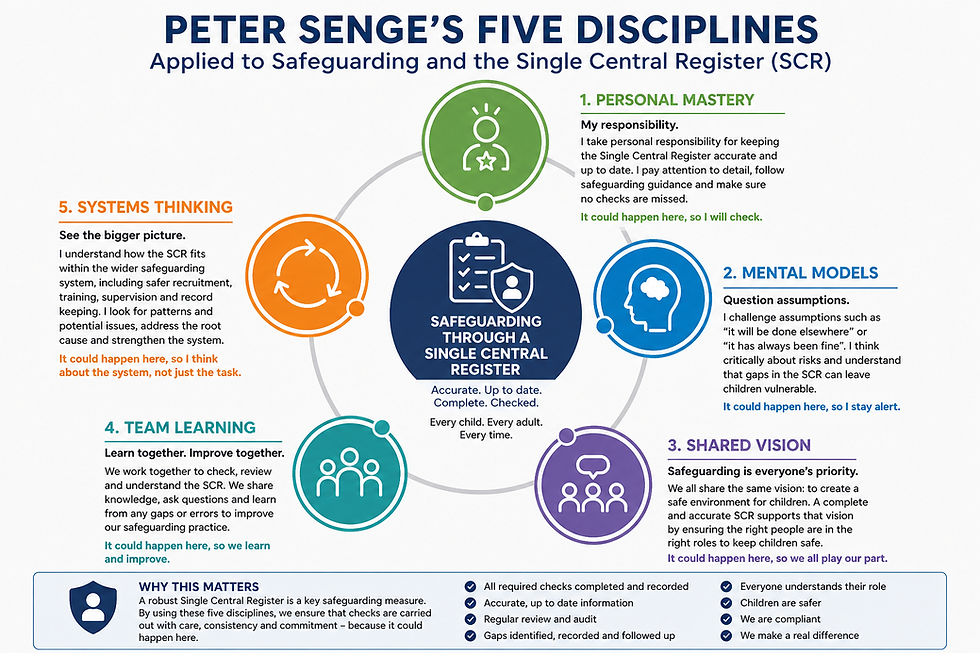
Safer recruitment includes accurate record keeping on a single central register (SCR) and the ability to accurately cross reference against recruitment files. Peter Senge's model helps us focus on its importance; the five disciplines highlight that SCR checking benefits from personal mastery through careful attention to detail, mental models through questioning assumptions, a shared vision around safeguarding, team learning through collaborative checking, and systems thinking through understanding how each check connects within the wider safeguarding framework. This supports an 'it could happen here' approach, where checks are carried out with consistent scrutiny rather than assumption.
If we focus on basics; the SCR can be digital but should have the ability to be in print-form; it is not only for teaching staff but for all staff including supply staff, salaried trainee teachers, volunteers, non-teaching staff, boarding staff and proprietors; and the dates of checks and who carried them out should be recorded, including the dates to document a review of the SCR- if there are any gaps identified these should be logged with a clear audit trail.
The information required on staff includes:
Role and start date
Pre-appointment evidence of identity & medical fitness.
Enhanced criminal record check & DBS certificate including a children's barred list check obtained before or as soon as practicable after that person’s appointment. An individual cannot apply for an Enhanced DBS check by themselves. There must be a recruiting organisation who needs the applicant to get the check. This is then sent to DBS through a Registered Body. However, the service is free for volunteers. Criminal records check reference numbers should be recorded.
A standalone barred list check. Check no-one is barred from regulated activity according to 2006 Childcare Act.
A prohibition from teaching check. Check no one carries out work, or intends to carry out work in contravention of a prohibition order, an interim prohibition order, or any direction made under section 128 of the 2008 Act, or any disqualification, prohibition or restriction.
Right to work in the United Kingdom checks & check of overseas workers having regard for guidance issued by the Secretary of State. This might include police checks or certificates of good conduct from relevant countries, and any additional risk assessment if such checks cannot be obtained.
Qualifications where applicable. For teachers, their qualified teacher status (QTS) is required and checked, and if someone is not required to hold QTS, that rationale should be clear.
References.
Suitability for teaching for EYFS staff.
Checks for proprietors and governing body countersigned by the Secretary of State.
Section 128 check for managers.
Further considerations include:
Are the SCR and recruitment files readily accessible?
Have you dismissed any staff for safeguarding reasons and have you made a referral to the Disclosure and Barring Service?
Have the details of an individual been removed from the single central record once they no longer work at the school or college?
For shortlisted candidates, have you carried out an online search as part of due diligence?
If volunteers are supervised, what risk assessments do you have in place?
Have you recorded when staff have had safeguarding training?
Have you recorded when staff have completed safer recruitment training?
A well-maintained SCR is not just a compliance task but a practical, shared commitment to safeguarding, ensuring that every check is carried out thoroughly, recorded clearly, and understood as part of a wider system that keeps children safe.


Comments